What is the churn rate? Definition
The churn rate is a metric representing customer attrition or turnover. It is a percentage-based statistic showing how many customers stop using a product or service within a specific period.
Measurements may include one or more of the following:
- subscription cancellations,
- instances where a customer does not renew an expiring contract,
- discontinuation of use (even while the contract is still active).
Important!
Churn is a metric indicating the number of lost customers.
The churn rate is the ratio of customers who leave to active customers, expressed as a percentage.
When it comes to the churn rate, it is crucial to take measurements – whether continuously or periodically – and compare the results; this enables the company to respond promptly to customer attrition and implement preventive and/or corrective measures.
For whom is the churn rate particularly important?
The churn rate measures the pace at which a company loses active customers. It is a particularly important metric for businesses that provide services or products via a subscription model, such as:
- telecommunications companies,
- creators of e-learning platforms,
- suppliers of products delivered on a recurring basis,
- SaaS (Software as a Service) providers,
- companies offering various online services.
Why is churn so important?
The reason is simple: generally speaking, retaining a customer is cheaper and more effective than acquiring a new one. Ideally, a customer acquired by a company stays with it – and its products or services—for many years. High LTV (Customer Lifetime Value -the total amount a customer spends throughout their relationship with your store or brand) is a goal companies should strive for, especially those based on a subscription model.
Recognizing that customer retention should take precedence over acquisition, successful companies constantly measure their churn rate and use the results as a basis for optimizing their operations.
How to measure customer churn? The churn rate formula
To determine the exact scale of customer churn, a specific formula must be applied to a specific period. For instance, if we wish to analyze a single month (such as May), we check:
- the number of customers as of May 1st (LK),
- the number of customers lost between May 1st and May 31st (UK).

Example
Mr. Grzegorz sells gadget sets via a subscription model. Recently, he has been facing a significant outflow of customers. At the beginning of May, he had 734 customers, yet over the course of the month, as many as 94 people cancelled the service. Applying the formula will allow him to easily calculate the churn rate and visualize the scale of the phenomenon:
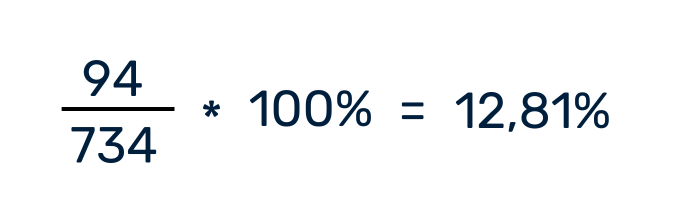
For Mr. Grzegorz’s company, the churn rate in May reached as high as 12.81%.
Is there a typical churn rate across different industries?
Is a churn rate of just under 13% cause for concern, or is it normal? It is time for that favorite answer to difficult questions: it depends. It depends primarily on the industry in which a company operates, but also on… whom you ask.
According to the “Average Churn Rate by Industry 2025” report published by CustomerGauge, the median churn rate is 11% for the energy sector and 19% for financial services; however, for logistics or subscription box services (such as Pixel Box or Mięsna Paka), the median churn rate reaches as high as 40%.
The agency Up&More reports that SaaS companies accept an annual churn rate of 5–10%, viewing any figure above 10% as a signal that corrective measures are required. The same article notes that streaming services typically record churn rates between 3% and 7%.
The data above makes one thing clear: there is no single benchmark statistic to use as a reference. Consequently, meticulously monitoring your own churn rate is crucial – ensuring you have a proper point of reference for the future.
What do changes in the customer churn rate tell us?
It is obvious that the lower the churn rate, the better. However, if we truly want to optimize rather than operate in the dark, we must understand exactly what causes the churn rate to rise or fall.
High and rising churn rate – what does it mean and how should you respond?
If customers are leaving and this trend persists (or intensifies) over time, it could mean a number of things. The most common reasons include:
Inappropriately selected pricing structure
It is important to bear in mind that the churn rate almost always spikes when prices are raised. In such a situation, an in-depth analysis is required to determine whether the price increase ultimately enabled the company to boost its revenue.
Example
A good example from recent months is the situation surrounding Microsoft’s Xbox Game Pass service. The drastic price hike in October 2025 (raising the Ultimate tier from $19.99 to $29.99 per month) met with such a negative user reaction that the company adjusted its pricing just a few months later, in April 2026. Ultimately, the price remains higher than it was prior to October 2025, but a clear adjustment was made (lowering the cost from $29.99 to $22.99 per month).
Product-market mismatch
Understanding market needs is crucial when launching new products. Consequently, if you fail to precede this step with appropriate research, you may face an unpleasant surprise. It often happens that, following an initial boom, customers drift away once they realize the product is not needed in the long run or fails to meet their needs.
Lack of knowledge of the target audience
Every change you introduce will elicit varied reactions. Customers are not a monolith holding a single opinion. In this context, your company faces several tasks:
- gaining a deep understanding of your audience,
- planning changes based on customer needs,
- accurately interpreting reactions,
- responding to them appropriately.
Example
This easily applies to the current business landscape: the ubiquity of AI elicits extreme reactions. Depending on your industry and customer base, you might experience an increased churn rate—for instance, because your company is rolling out AI-driven solutions too quickly or without sufficient forethought.
However, it cuts both ways: your customers might also leave if you delay implementing AI features.
The reason? Competitors are moving faster and more efficiently, offering more and demonstrating continuous growth. Yet, we shouldn’t reduce this to a “damned if you do, damned if you don’t” scenario. Your priority should be delivering products and services that your customers value. By thoroughly understanding their needs, you can easily correlate churn rates with the decisions your company makes.
Lack of customer support or difficulties obtaining support
In businesses that rely on customer retention – especially subscription-based ones – reliable and efficient customer support is absolutely essential. If a customer signs up for a subscription but hits a wall when facing their first issue (such as sluggish support, difficulty contacting the company, or long waits on the hotline – the reasons can be numerous), they will be highly motivated to quickly find the cancellation button.
If you want to build a subscription business, focus on nurturing customer relationships – and an efficient support team is vital for that.
How can the churn rate be reduced?
If you want to reduce your customer churn rate and bring it as close to 0% as possible, you can implement some of the following measures:
- monitoring the churn rate,
- improving customer service,
- enhancing the user experience,
- development based on the needs of loyal customers.
Monitoring churn rate
Customer churn rates rarely remain constant over the long term. It is worth revisiting this statistic at least once a month; doing so provides a dataset that is easy to compare, allowing you to draw reliable conclusions.
When measuring the churn rate, take into account your business’s peak and off-peak periods (where applicable), as well as the times immediately following major organizational changes. Do not limit yourself to raw numbers. Supplement each churn rate measurement with a brief description or a few sentences to ensure the context remains clear, even if you review the data weeks or months later.
Improving customer service
While customer service is always important, companies operating on a subscription model must place special emphasis on it. A long-term user of an app or tool has different needs than someone just beginning their journey with your company’s products or services. A veteran user’s questions will be more complex and specific, often centering on particular use cases. Consequently, this requires a higher level of expertise from the specialists on the other end of the line or keyboard.
Providing multiple communication channels is equally important. Customers may cancel your services simply because support is inaccessible to them. For many, a contact form or email address is insufficient. A phone line available only between 8:00 AM and 4:00 PM also poses a problem for those working during those hours.
Potential solutions include extending or adjusting support department hours, or implementing chatbots and live chat features that allow users to communicate with a consultant in real-time via text.
Improving the customer experience
Customer experience encompasses the entirety of the impressions a customer forms after interacting with your brand. Your goal is to design the purchasing journey—as well as the post-sales support process – in a way that ensures the customer experience is consistently positive. The aim is for the customer to feel satisfied both after the purchase and while using your products or services.
Customer experience comprises:
- functional and easy-to-navigate websites,
- excellent customer service,
- clear and accessible pricing,
- personalization,
- wide availability of convenient payment methods,
- fast shipping or quick service activation.
Development based on the needs of loyal customers
If you wish to establish a business relationship with a counterparty based outside the European Union, it may prove necessary to use specific databases or order a report from an international business intelligence agency. Let’s start with the simpler solution.
How do you check a business partner from a non-EU country?
Acquiring new customers is important, but it should not be your company’s primary goal—the greatest value lies in your existing customer base.
Planning business growth around the needs of loyal customers is a proven, effective way to reduce churn.
Another best practice that should go hand-in-hand with this is rewarding customer loyalty. Launching loyalty programs is a relatively low-cost yet effective technique for securing the support of loyal customers for years to come.
While many online search tools can be helpful, they cannot answer questions regarding a business partner’s credibility. They can tell you whether a company is active, registered for VAT, and if the details provided by your contact person are authentic. While this information is crucial, it does not always reveal key details about a partner’s financial standing or debt levels.
Specialized debt registers and reports prepared by international business intelligence agencies can address these needs. These services go beyond publicly available data from government or state databases; they also monitor websites, company-published materials, media coverage, social media, legal events, financial statements, and debt registers.
Using business intelligence services comes at a cost, but when significant sums of money and considerable uncertainty regarding a potential partner are involved, it is certainly an option worth considering.
Summary
The churn rate is a metric measuring customer attrition—a figure significant for almost any business. However, it is particularly crucial for companies operating on a subscription model, primarily because retaining existing customers is far less expensive than acquiring new ones. Tracking the churn rate enables businesses to respond effectively to customer attrition and take appropriate steps to reduce the number of cancellations.
Key to this process is the regular monitoring of the metric, the provision of comprehensive, expert, and efficient customer service, and making business decisions with a primary focus on loyal customers.
Frequently asked questions
What is churn rate?
Churn is the absolute number of customers lost during a given period.
If a company had 500 customers at the beginning of the month and currently has 463, the churn is 37.
What is the definition of churn rate?
The churn rate is a metric representing the ratio of customers who discontinue a company’s services to active customers.
If a company had 500 customers at the beginning of the month and the churn figure is 37, the churn rate is 7.4%.
For whom is the churn rate particularly important?
Churn rate is a crucial metric for subscription-based businesses, such as:
- SaaS,
- telecommunications companies,
- streaming service providers,
- subscription box companies.
What is a typical churn rate?
This value depends on the industry in which the company operates, the sales model, and many other factors. Here are some examples:
- subscription boxes – approx. 40%,
- financial services – approx. 19%,
- SaaS – 5–10%,
- streaming services – 3–7%.
How can the churn rate be reduced?
To reduce the customer churn rate, the following measures should be implemented:
- regularly monitoring the churn rate,
- improving customer service,
- launching loyalty programs,
- prioritizing the customer experience,
- addressing the needs of loyal customers.