How does Google AI Overview work?
First, a user types a phrase into Google. Then algorithms scour the web for the most relevant results for that person. After just a few seconds, a neat box appears to the eyes of the searcher, which contains a relatively brief summary of the most important news – divided by sub-headings and put into short bullet points. This is Google AI Overview – in Poland functioning as “Overview from AI”.
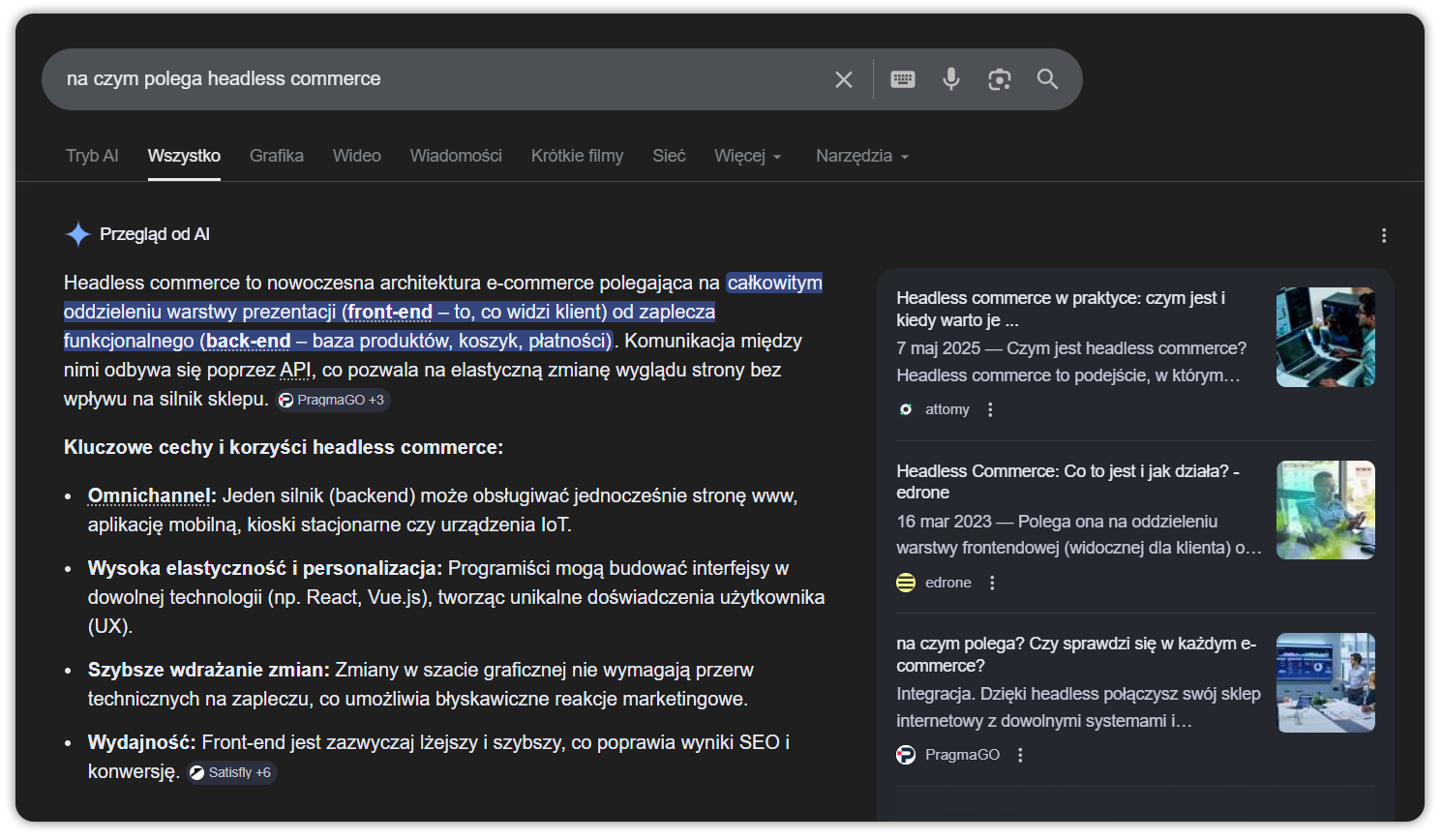
From your company’s point of view, however, the most important thing is that the source of the information given is added to each piece of AIO (AI Overview) – and that source with a link.
So when the user reads the first sentences of the summary, he can:
- Leave the search engine if the information gained is enough for him.
- Check where the information given comes from and click on the link to the source (usually the one given first).
- Read the summary to the end.
This ramification means that clicks – while still important – are not necessarily the primary goal of content optimization. It is visibility that should be a priority.
Even if the user doesn’t click on the link, the mere presence of your brand at the top of the AI summary is extremely valuable – it increases the chances of a classic conversion (click and go to the page), but also builds brand awareness by putting it in the right context.
Google AI Overviews versus Featured Snippets – what is the difference between these two widgets?
The distinction between the two is relatively simple:
- Google AI Overview collects information from multiple sources and presents it in the form of snippets taken from various websites. It can include both text and multimedia elements.
- A Featured Snippet is a single element – a snippet of text (usually a list or table), a video or a graphic, which is an answer to a question (a typed phrase). The entire featured snippet (in Poland it appears as “Excerpt with answer”) is content taken from a single source.
Important!
We focus on optimizing for Google AIO, not featured snippets with answers, for one simple reason. In 2026, the incidence of featured snippets is much lower than in previous years – response snippets have lost their position precisely to Google AI Overviews.
What does AI Overview consist of?
Here are the highlights of Google AI Overviews:
- AI-generated content: the algorithm compiles answers from multiple sources. The result is the most likely possible answer to the question (phrase entered).
- Links to sources: the key point is that AI Overview includes links to the sources it draws from. This is why it is so important to take care of visibility for language models (LLMs). With links, customers are able to go to the source and acquire more information. For your brand, this is an opportunity to increase visibility and organic traffic.
- Always at the top of search results: The overview from AI is always in the upper regions of the SERP (Search Engine Result Page). As a result, the information contained there is most visible.
- Dynamic form: the answers presented in the AIO do not have to contain only text. They are often enriched with graphic content, videos, tables. It all depends on the type of query and availability of sources. In this respect, the Review from AI has taken over the functionality of the answer passages we mentioned earlier.
How is Google AI Overview changing the rules of SEO?
Browsing from AI isn’t just an “answer box.” It’s a fundamental change in the way users interact with the search engine. It’s becoming increasingly rare for searches for answers to questions to end with the opening of several new tabs in the browser. More often, users focus on what they will get in an overview because it is:
- Fast (AI Overview’s answer generation usually takes little longer than showing classic search results, and the answer is sometimes satisfactory.
- Easily accessible (no need to scroll down, go through many websites – the answer is given on a tray, right here and now).
- Credible (links to sources indicate that specific brands and even specific content creators are behind the content in the Review from AI.
The Great Decoupling and the “crocodile effect”
The phenomenon of The Great Decoupling is a situation that is a direct result of the introduction of Google AI Overviews. Prior to the introduction of Overviews from AI, an increasing number of impressions on a website was always associated with an increase in clicks.
Today, that relationship has been shattered – brands whose content is featured in AI Overviews are seeing two effects:
- Increase in the number of impressions – this is due to the fact that each display of a piece of content in the Overview counts towards the statistics.
- Decrease in the number of clicks – users often settle for so-called zero-click search, i.e. information gained without clicking on links to sources.
These effects create a growing chasm resembling an open maw, hence the name – the crocodile effect.
What about the rest of the content? The ones that don’t make it to AIO? They are recording a significant drop in impressions. So while there is no crocodile effect in their case, the results are getting worse. This is why visibility is becoming a priority.
So how do you prepare for your brand to start showing up in AI Reviews? You need to know what makes some of your content go there and some not.
How does AI select content suitable for Reviews?
The factors influencing which content will make it into Google AI Overview are many. Among the most important are:
- Credibility and authority of the source. A key factor for visibility in AI is meeting Google’s EEAT standards. This is a set of four characteristics (experience, expertise, authority and credibility) that must be met not by the content itself, but by the source from which it comes.
- The quality of your content and how it helps your audience. The content you post on your brand’s website should be helpful – responsive to users’ needs. Guidelines in this regard are gathered in the Helpful Content System developed by Google.
- Compatibility of information with other sources. Before deciding whether your content should be featured in Overviews, algorithms will verify that similar information also appears elsewhere on the Internet. For example: if you provide statistics, but they are not corroborated by other sources, the chances of visibility in AIO drop dramatically.
- Timeliness of the information contained in the content. This factor does not apply to every type of content, but it is important when time is of the essence in the topic being covered. If a user is looking for information about animal species, the timeliness of the content will be rather irrelevant. However, if he types the phrase “tax changes in Poland” he expects information as recent as possible – and such will be given preference by the algorithm.
How to optimize content for Google AI Overviews – practical steps
The theory is over, time for practice. Here are 6 elements that you can implement in your company so that your content begins to be recognized by language models, and thus make it to AIO Reviews.
Quality content is key
Although it may seem obvious to the point of hollowness, the most important thing is the quality of the content. Even the most fancy optimization methods and meeting dozens of technical criteria cannot compete with texts:
- reliable,
- original,
- helpful to users,
- accurate,
- kompleksowymi.
When creating content related to your brand, keep the above features in mind. Pay special attention to whether your texts are written with users in mind who are looking for answers to their questions – this is a particularly valued criterion by Google.
How to take care of the E-E-A-T?
Your site should appear as a credible source of information, and the people creating the content – as authorities in their fields. The ideal situation is when this is already the case – when your brand and authors are perceived in the audience as trustworthy and with considerable authority. However, if this is not the case – you need to build this impression (and back it up with strong arguments).
What can you do to build an E-E-A-T?
- Take care of your website’s security. A credible website must not compromise the security of user data. Be sure to have an SSL certificate, proper security features, RWD (Responsive Web Design) compliance.
- Build a transparent site. Highlight contact information so users know they are dealing with a real, viable company, not a post. Give users multiple ways to get in touch (not just email or a contact form, but also a hotline, live chat or the ability to contact you on social media).
- Get feedback from customers. In an age of limited trust on the Internet, reviews are fundamental to the credibility of your website. Remember, however, that it’s not about issuing laurels to yourself – anonymous reviews posted on company websites mean as much as last year’s snow. The real value comes from reviews published on third-party portals and platforms that collect opinions.
- Reaffirm your brand’s authority externally. Try to get your company talked about elsewhere – in industry portals, on other brands’ websites, on social media. Get valuable links leading to your content, solicit mentions in reports, industry publications and rankings.
- Expose content authors. One of the pillars of EEAT is expertise – show that your company is a group of professionals and experts. Create content author profiles on your website. If you have a company blog, sign articles with the authors’ names, link to their social media profiles. Algorithms will check their credibility just like your site – if they come across other authors’ articles in external sources, they will consider that they have authority. If you create corporate video content, show the people responsible for it on the video.
- Collaborate with people who are recognized in the industry. If your authors are just starting out, invite writers from the industry who are already recognized. Ask them to write content for your brand or include their contributions in your content. This will also build brand authority.
What is search intent and how to understand customer intent?
In order to know how to create effective content, you need to know what the customer’s intentions are when they type search queries – that’s search intent. Try to answer the following questions:
- What is your audience looking for?
- What problems do they want to solve?
- How do they ask questions?
These three aspects are key to understanding user intent. When creating content – whether it’s plain text, infographics or videos – try to answer the questions you haven’t asked (yet).
What does this mean? Here are some practical examples:
- Instead of “Google AI Overview under a magnifying glass,” write “How does Google AI Overview work?” – the former may sound better, but it requires an extra layer of interpretation and is less direct.
- Instead of “The customer’s intent is unsearchable,” write: “What is search intent and how to understand the customer’s intent?” – Again, the priority should be to answer the question the user is likely to ask.
Observe how Internet users construct queries on the Internet. Recall how you do it, and then ask yourself, “is there room for literariness in this?”. Quality content on the Internet is not the same as quality literary text.
How to create comprehensive content?
One of the pillars of quality content is its comprehensiveness. The more in-depth you go into the topic covered, the more authority you will build and the more expertise you will demonstrate.
In each article, try to:
- touch on related topics – even if you only end up with a mention (preferably with a link to the full content on the topic),
- answer the most frequently asked questions,
- Refer to statistical data or statements by respected experts.
Comprehensive, well-structured content is both helpful to users – in the sense that it is sufficient for them. Construct your texts in such a way that readers don’t need to go to other articles anymore.
More information and data in the text also means a more powerful base for LLMs, which are all the more eager to extract the content and put it in the Review from AI – which is, after all, what you care about.
Important!
The comprehensiveness of the text is not necessarily related to its length. If you have already covered all the relevant topics – finish the work. It is good to set yourself an expected volume of the article, but if you want to write texts of about 15 thousand characters with spaces, and after exhausting the topic you have 8 of them – do not try at all costs to “hit” the limit.
Take care of the technical side of the content
Divide articles into clear sections that you separate with headings. Use H1, H2, H3 and so on headings to divide content into chapters, subsections and smaller sections. Such text structure will benefit both readers and AI algorithms, which will find it easier to comb through the article for specific content.
What else can you do?
- If you introduce terms that may not be obvious to readers, include their definitions in the text as well.
- Try to build short sentences.
- Create concise paragraphs with no more than 5 sentences.
- Include bulleted and numbered lists in texts.
- Pay attention to the terms used – if you use substitutes, indicate their presence already at the beginning of the text.
How to make it easier for algorithms to work?
Finally, I have two techniques for you that will make the job of language models easier and, of course, increase the chances of your content appearing in AI Overviews.
First: at the end of the article, include a FAQ section – frequently asked questions. The FAQ will act as a summary of the article and will be a valuable resource for language models and hurried readers. Check out the FAQ section for this article, which can be found directly below this section.
Second: use structured data (schema.org).Schema tags are elements that allow algorithms to more easily interpret passages of text. Among the most commonly used tags are:
- FAQPage – this is how we label the FAQ section.
- Author or Organization – is used to label authors and brand and build the authority of the site.
- Product – used on product pages.
- HowTo – to mark the sections explaining the step-by-step processny.
Summary – how to take care of visibility in AI overviews?
Google AI Overviews have had a strong impact on how content should be created and positioned online. It has shifted the burden of conversion from clicks to views – and has required professionals to change the way they create and optimize content. However, it’s still uncharted territory for many brands – take advantage of this fact and start optimizing content for Google AI Overviews as soon as possible!
Frequently asked questions
What is Google AI Overview?
Visible in Poland as “Overview from AI,” Google AI Overviews are abbreviated answers presented at the top of a search page. These answers are generated by an algorithm based on a synthesis of information from multiple sources.
What factors are most important in optimizing content for AI Overview?
- Credibility and authority of the source (compliance with E-E-A-T).
- Whether the content is helpful to users (Helpful Content System compliance).
- Compatibility of information with other sources.
- Timeliness of data (in some cases).
What practical measures should be implemented to increase visibility in LLMs?
- Create quality content.
- Take care of the site’s security.
- Build a transparent site.
- Get real customer feedback.
- Show content authors.
- Try to get mentions and citations in other sources.
- Write comprehensive articles.
- Take care of the technical side of the content.
- Include FAQ sections in the texts.
- Use structured data.





 01.04.2026