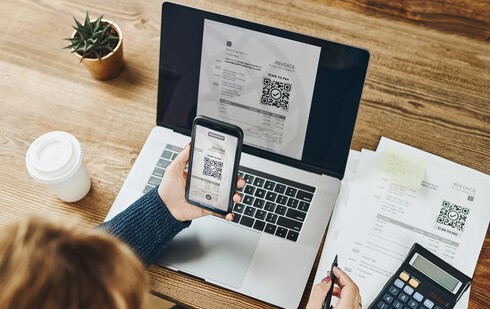
Types of invoices in a company
Before we describe each type of invoice, we need to clarify an issue that is regulated by the VAT Law. The correct type of invoice is indicated not by its name, but by the data on the document. This means that even if you write “VAT invoice” in the title of the document, but lack important data on it, such as the date of issue, the document will not be an invoice in the eyes of the law.
What types of invoices do we distinguish?
In business transactions we can encounter 10 types of invoices:
- sales invoice;
- advance invoice;
- final invoice;
- correction invoice;
- Margin VAT invoice;
- VAT invoice of a small taxpayer;
- RR VAT invoice;
- an invoice from a VAT-exempt taxpayer;
- pro forma invoice;
- simplified invoice;
We have marked in bold letters those types of invoices in the company that entrepreneurs encounter most often.
Sales invoice (VAT invoice)
This is the most common type of sales document – we can encounter it in both retail and wholesale.
A sales invoice can be issued by the company selling the goods or performing the service. Its recipient will be an entrepreneur or an individual – the buyer of the goods or services. VAT invoice must be issued within 15 days of the last day of the month in which the service was performed (goods delivered).
What the sales invoice must contain:
- data of the issuer of the invoice and the buyer of the goods (services);
- invoice number;
- the name of the goods (service), the quantity or number of goods sold (description of the scope of the service provided);
- the net price, gross price, as well as the rate and amount of VAT (if applicable);
- date of issuance of the document or delivery of goods (performance of services).
What the sales invoice does not have to contain:
- title (though it won’t hurt in any way);
- originality determinations;
- signature;
- stamps.
Important!
If the VAT invoice issuer is an exempt taxpayer, it does not have to include the amount and rate of tax on the invoice. Instead, it is necessary to indicate the basis for VAT exemption.
Advance payment invoice
If the actual transaction is preceded by an advance payment, the resulting payment should be documented with an advance invoice. This document functions as a confirmation of the advance payment, although it can also be issued before part or all of the amount is received.
What an advance invoice must contain:
- invoice number;
- data of the issuer and purchaser (names, surnames, addresses, tax ID numbers);
- date of issue and date of receipt of receivables (only if they differ);
- the amount of the advance payment and input tax;
- the name of the goods (service), the quantity or number of goods (description of the scope of service);
- the unit price and the total value of the goods (services).
Important!
In a situation where the advance invoice covers only part of the value of the transaction, the seller must issue a final invoice at the time of execution.
Final invoice
This type of invoice is used to account for advances, down payments and other partial payments for which the seller has previously issued advance invoices.
What the final invoice must contain:
- the amount to be paid less advances received;
- a list of the advance invoices drawn up for this transaction:
- advance amounts;
- advance invoice numbers;
- issue dates.
Corrective invoice
Errors can creep into any document, but in the case of an invoice, a paraphrase is not enough – a correction invoice is required. When will we use it?
- When we give a discount, rebate or price reduction;
- When we return goods or packages;
- When we return a payment (in whole or in part);
- When there is a mistake in any invoice item.
What the correcting invoice must contain:
- Title “correction invoice“;
- Number and date of issue;
- The reason for the need to make the adjustment;
- Data from the invoice to which the correction relates:
- the number and date of issue of the document or delivery of goods (performance of services), if different from the date of issue;
- data of the issuer and purchaser;
- the name of the goods (services) covered by the adjustment;
- The amount of adjustment of the tax base or output tax.
Important!
A correcting invoice cannot be issued in place of a destroyed document – in such a situation, a duplicate invoice .
Margin VAT invoice
Another type of invoice is used in certain cases specified by law:
- In the sale of used goods;
- In selling travel services;
- In the trade of collector’s items, antiques and works of art.
The main difference is the subject of taxation – in the case of a margin VAT invoice, only the amount of margin charged by the seller of the goods (service) is subject to it.
Important!
In addition to the standard data, the markup VAT invoice should indicate the type of business of the entrepreneur who issues the document:
- margin procedure – travel agencies;
- margin procedure – used goods;
- margin procedure – collector’s items and antiques;
- margin procedure – works of art.
VAT invoice of a small taxpayer
This is a type of invoice designed for those who settle on a cash basis. The only difference between a small taxpayer’s VAT invoice and a regular one is the “cash method” endorsement that must be placed on the document.
RR VAT invoice
This type of sales document is used in transactions involving flat-rate farmers. The RR VAT invoice is issued by the buyer of agricultural products.
What the RR VAT invoice must contain:
- a marking with the content “RR VAT invoice”;
- data of the buyer and supplier of goods (names, surnames, short names, addresses, TIN or PESEL);
- series and number, date of issue, and the name of the issuing authority of the supplier’s ID card, if the supplier is an individual;
- the invoice number and the date of its issuance and purchase of products (if different);
- the name and number of purchased goods, their unit price and value without the amount of the flat tax refund;
- the rate and amount of the flat tax refund;
- the total value of the goods;
- the amount of total receivables;
- signatures of persons authorized to issue and receive the invoice;
- supplier statement.
Important!
The statement mentioned at the end of the list has a fixed content: “I declare that I am a flat-rate farmer exempt from value added tax under Art. 43 para. 1 item 3 of the Value Added Tax Law.”
Invoice of a taxpayer exempt from VAT
A VAT-exempt taxpayer can also issue an invoice. In addition to the standard data, it should include the legal basis for the exemption.
Important!
If a taxpayer enjoys an entity exemption of up to PLN 200,000, he does not have to indicate the basis.
In the event that the company is exempt from tax under Art. 43 para. 1 pt. 7, 37-41, the invoice can only include:
- date of issue and number;
- party data;
- service name;
- amount.
Pro forma invoice
This document has no tax consequences, although it must contain the same set of data as a regular sales invoice. In fact, a pro forma invoice is not an accounting document, but only an auxiliary one.
It is issued to give the buyer information about the price of the goods or services in which he is interested. A pro forma invoice does not relieve you of the obligation to issue a VAT invoice within the usual timeframe.
Simplified invoice
This type of invoice can be issued by an entrepreneur only when the amount due for goods or services does not exceed PLN 450 or €100. A simplified invoice cannot be issued to document domestic mail order sales, intra-Community supply of goods, and supply of goods and services to EU entities.
What a simplified invoice must contain:
- the date and number of the invoice and the date of delivery of goods or performance of services (if different);
- details of the seller and the buyer;
- the name of the good (service);
- the amount of discounts, rebates, rebates, if they are not included in the unit price of the goods (services);
- the amount of total receivables.





 19.08.2026